If you’re doing $10K a month on Amazon and feel stuck – you’re not alone.
Most Amazon sellers hit a ceiling around this point. Sales are coming in, but growth has flatlined. You’re spending more on ads, margins are tightening, and you’re not sure what to fix first.
The good news? Getting from $10K to $100K/month is not luck. It’s a repeatable system.
At Ecom Scaleup Agency, we’ve helped sellers break through this exact plateau – including one client who grew their Amazon revenue by 143% within a single managed period. In this guide, we’re breaking down the exact steps that make that kind of growth happen.
Why Most Amazon Sellers Get Stuck at $10K/Month
Before jumping into solutions, it’s worth understanding why growth stops here.
The $10K ceiling usually comes from one of four problems:
- Listings not converting – Traffic is coming but buyers aren’t clicking “Add to Cart”
- PPC eating all the profit – Ad spend is high but ACoS is out of control
- Inventory issues – Running out of stock or over-ordering kills momentum
- Account health problems – Warnings and policy flags slow everything down
Fix these four things and $100K/month becomes achievable. Here’s how.
Step 1 – Fix Your Listings Before Spending More on Ads
This is the single most important step and most sellers skip it.
Sending paid traffic to a weak listing is like pouring water into a bucket with holes. Before increasing ad spend, your listings need to be conversion-ready.
What a high-converting Amazon listing needs:
Title: Your product title should include your main keyword naturally in the first 80 characters. Amazon’s algorithm reads this first.
Example of a weak title:
“Blue Water Bottle 32oz”
Example of a strong title:
“32oz Insulated Water Bottle – Leak-Proof, BPA-Free, Keeps Drinks Cold 24 Hours – Stainless Steel Flask for Gym, Hiking, Travel”
Bullet Points: Five bullet points, each starting with a CAPITALIZED benefit. Lead with what the customer gains, not what the product has.
Images: Minimum 7 images. Main image on white background. Additional images should show the product in use, size comparisons, and key features called out with text overlays.
A+ Content: If you’re Brand Registered, A+ Content can increase conversions by 5–10% on its own. Use it to tell your brand story and reinforce trust.
Backend Keywords: These are invisible to buyers but read by Amazon’s algorithm. Fill every character of backend search terms with relevant keywords your title couldn’t fit.
Step 2 – Get Your PPC Strategy Right
Amazon PPC is where most sellers waste money – and where the biggest wins hide.
The goal is not to spend as little as possible. The goal is to spend efficiently. There’s a big difference.
The three campaigns every scaling seller needs:
1. Auto Campaign – Let Amazon find keywords for you. Run this at a low bid ($0.30–$0.50) to collect data. After 2–3 weeks, harvest the search terms that converted and move them to manual campaigns.
2. Manual Exact Campaign – Take your best converting keywords and bid more aggressively on them. These are your money keywords. Protect them.
3. Manual Broad Campaign – Use this for discovery. It catches variations and long-tail searches you haven’t thought of yet.
Key metrics to watch:
- ACoS (Advertising Cost of Sale): Keep this below your profit margin. If your margin is 30%, ACoS should be under 25%.
- TACoS (Total ACoS): This is your ad spend divided by total revenue including organic. As organic sales grow, TACoS should drop. This is your real growth indicator.
- Search Term Report: Review this weekly. Negative keyword terms that waste money and add converting terms to exact campaigns.
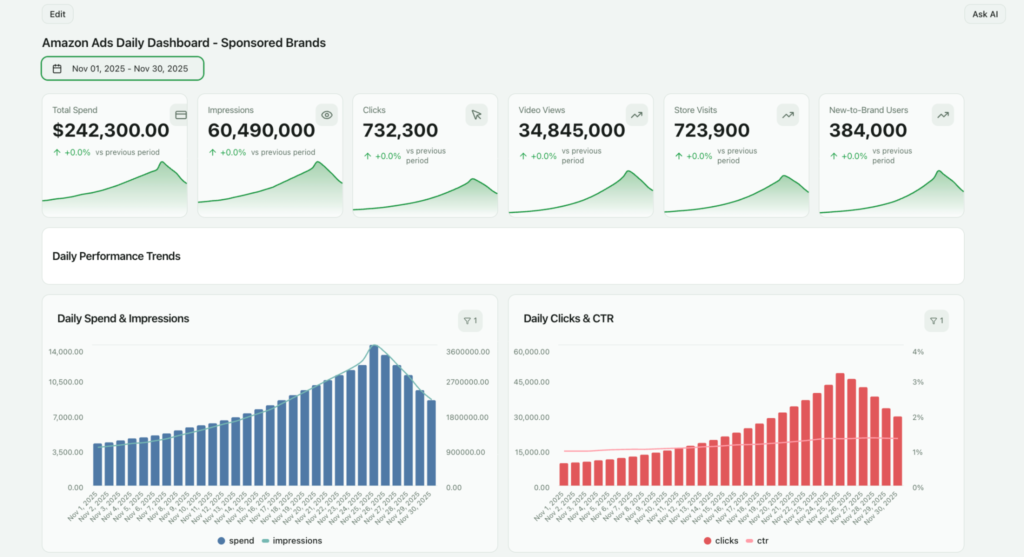
One of our clients was running a 48% ACoS when they came to us. Within 90 days of restructuring their campaigns, ACoS dropped to 22% while revenue increased. That’s the power of fixing structure, not just budgets.
Step 3 – Choose the Right Business Model for Your Goals
This is something most guides don’t talk about – but it changes everything.
Your path from $10K to $100K looks completely different depending on which model you’re using.
Dropshipping (16% ROI)
Low barrier to entry, no inventory risk. Good for testing products quickly. Margins are thinner so volume matters more. You need strong listing optimization and pricing discipline to scale here.
2-Step Dropshipping (20% ROI)
A more sophisticated version that works well on Amazon. Higher margins than standard dropshipping but requires tighter supplier relationships and order management.
Wholesale (30% ROI)
You buy established branded products at wholesale prices and resell on Amazon. Higher margins, more predictable, and easier to scale because the brand already has demand. Requires upfront capital.
Private Label (30–40% ROI)
You create your own brand on an existing product. Highest margins and the most defensible business long-term. Takes longer to launch but compounds beautifully. This is where the biggest Amazon businesses are built.
If you’re at $10K/month and want to reach $100K, wholesale and private label give you the margin room to invest in growth without watching every dollar disappear into fees and ad spend.
Step 4 – Fix Your Inventory Management
Nothing kills Amazon growth faster than going out of stock.
When your listing runs out of inventory, your ranking drops. Sometimes it never fully recovers. Rebuilding organic rank after a stockout can take weeks or months – and costs money in PPC to recover.
The basics of inventory management at scale:
Know your sell-through rate: How many units are you selling per day? Multiply by your supplier lead time plus shipping time to Amazon FBA. That’s your reorder point.
Build a safety buffer: Add 20–30% on top of your calculated reorder point. Supply chains have delays. Amazon receiving can be slow. Buffer stock protects your rank.
Avoid long-term storage fees: Amazon charges fees for inventory sitting in FBA warehouses beyond 365 days. Review your aged inventory regularly and either discount to move it or remove it.
Use IPI score as your guide: Amazon’s Inventory Performance Index scores your account on in-stock rate, excess inventory, and stranded inventory. Keep this above 450 to avoid storage restrictions.
Step 5 – Protect and Maintain Your Account Health
You can have perfect listings, great PPC, and solid inventory – and still get shut down if your account health is poor.
Amazon is strict. Ignoring account health notifications is one of the fastest ways to lose everything you’ve built.
The metrics Amazon watches:
- Order Defect Rate (ODR): Must stay below 1%. This covers negative feedback, A-to-Z claims, and chargebacks.
- Late Shipment Rate: For FBM sellers, must stay below 4%. FBA sellers are mostly protected here.
- Valid Tracking Rate: Must stay above 95% for FBM orders.
- Policy Compliance: Any active policy warnings need to be addressed immediately with a Plan of Action.
Check your Account Health dashboard every single week. Don’t wait for Amazon to email you. By the time they do, you may already be at risk.
Step 6 – Expand to Multiple Platforms
Once you’re running a stable $10K–$20K/month Amazon business, the fastest way to $100K is adding platforms – not just growing Amazon alone.
Where to expand:
eBay – Massive buyer base, less competition than Amazon for many categories, and no FBA required. One of our clients grew their eBay store by 90% after adding professional account management.
Walmart Marketplace – Growing fast. Less saturated than Amazon right now, which means cheaper ads and easier ranking. Approved sellers get strong visibility.
TikTok Shop – The newest opportunity. Products go viral and sell in volumes that are difficult to replicate on traditional marketplaces. Best for brands with visual products.
Shopify – Build your own DTC channel to capture customers outside the marketplace and improve margins by removing Amazon’s fees entirely.
Sellers who operate across three or more platforms consistently outgrow single-platform sellers. The traffic diversification also means one platform’s algorithm change won’t kill your business.
Step 7 – Know When to Get Expert Help
There’s a point where managing everything yourself becomes the bottleneck.
Listings, PPC, inventory, account health, platform expansion, customer service – at scale, each of these is a full-time job. Most sellers who are stuck at $10K are trying to do all of it themselves.
This is where a professional marketplace management agency changes the equation.
At Ecom Scaleup Agency, we’ve managed 500+ accounts across Amazon, eBay, Walmart, Shopify, and TikTok Shop. Our clients don’t just get management – they get a team that treats their account like a business, not a ticket.
Our results speak for themselves:
- +143% Amazon revenue growth for a managed seller
- +90% eBay store growth through listing and account optimization
- +82% Shopify conversion growth after store build and management
If you’re serious about breaking through to $100K/month, the question isn’t whether you need help – it’s whether you want to figure it out alone or with a team that’s already done it.
Ready to Scale Your Amazon Store?
At Ecom Scaleup Agency, we offer a free Growth Audit where we review your Amazon account, identify your biggest growth blockers, and show you exactly what we’d do to scale it.
No pitch. No pressure. Just a clear picture of where your store stands and what’s possible.
[Book Your Free Growth Audit]
https://ecomscaleupagency.com/contact-us/